Showing posts with label vegetable. Show all posts

Wednesday, April 1, 2009

Eat, Grow and Raise Rare Varieties

I was following up on one of my posts on a forum I belong to and realized that I had not yet posted this information on this blog.

The example I posted earlier about the broccoli and the fact that Idaho grows so many potatoes should bring to light one of the problems I see in agriculture today.

In the old days, farmers (including very large farms) grew a multitude of crops. People knew that they could get whatever they wanted within a short distance. But these huge Ag companies have narrowed down the varieties of what they grow. Now we have huge areas that only grow one vegetable. In fact, only one variety of vegetable. Now, what happens when a disease comes through an area? You get crops completely wiped out.

It is what happened when the blight wiped out the potatoes and caused the great Irish famine.

The same thing happened with the bananas. We began growing almost exclusively one variety of banana, the Gros Michel, a banana that was larger and, by all accounts, tastier than the fruit we now eat. A fungus called Panama disease began infecting it and by the 60's it was virtually wiped out. Now what we think of as the banana is actually a second rate replacement called the Cavendish. If it happens again, the third variety down the line is a pretty poor substitute. And, in 1992, a new strain of the fungus, one that can affect the Cavendish, was discovered in Asia and most experts agree that we have major problems coming. We may not have bananas as we know them in ten years.

Because of these giant Ag companies taking over our food supply we are losing varieties of fruit, vegetables and farm animals at alarming rates.

Here are some examples:

96-98% of the commercial vegetable varieties available in 1903 are now extinct.

Reliance upon modern varieties of rice caused more than 1,500 local rice varieties in Indonesia to become extinct.

In the USA, only 5% of the apple varieties that existed 200 years ago still remain.

In the UK, 90% of vegetable varieties have disappeared over the last century.

99% of all turkeys raised in the U.S. are Broad-Breasted Whites, a single turkey breed specially developed to have a meaty breast.

83 percent of dairy cows are Holsteins, and five main breeds comprise almost all of the dairy herds in the US.

60 percent of beef cattle are of the Angus, Hereford or Simmental breeds.

75 percent of pigs in the US come from only 3 main breeds.

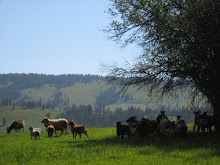
Over 60 percent of sheep come from only four breeds, and 40 percent are Suffolk-breed sheep.

The less varieties we have of all of our food the more of a chance that we can have them wiped out by disease or by climates that they are not meant to be grown in. The varieties being lost were developed in micro climates and were able to thrive. When we try to grow the same variety everywhere we are looking for trouble.

So, buy heirloom varieties when growing your garden. If possible pick wacky varieties that are at risk of extinction. Keep them alive. We are all part of the solution.

On our place, every variety of vegetable in my garden is an heirloom and our sheep, horses and chickens are all rare breeds.

Do what you can and can what you do.

Wednesday, March 18, 2009

Vegetables, Chickens, Fruits, Nuts and Bee's - An Update

Just a quick update.

Vegetables
On the 13th, I started a bunch of my vegetables and herbs, including:

Asparagus- Mary Washington
Broccoli- Decicco
Siberian Pepper- Grandpa's Home Pepper
Bell Peppers- Early Mountain Wonder
Early Tomato- Sub-arctic Plenty
Early Tomato- Gem State
Brussel Sprout- Long Island Improved
Leeks- King Richard
Kale- Red Russian
Early Cabbage- Early Mountain Wakefield
Chinese Celery- Kan Tsai
Mache/Corn Salad- Verte De Cambrai
Red Romaine- Cimmaron
Spinach- Bloomsdale Long Standing
Red Leaf Lettuce- Red Saladbowl
Sweet Basil- Ocimum Basilicum
Italian Parsley- Plainleaf

Chickens
Last night I finally took the 34 chicks out of our walk in shower. We moved them to a heated room in our barn. I think they are enjoying the new casa.

Fruits and Nuts
Today we planted two new walnut tree's as well as two new peach tree's. I'm not sure how many fruit and nut tree's that makes between my parents and us. It must be 50 or more. You can never have too many though, in my opinion. And nothing beats a freshly picked peach in the summer.

Bee's
When we arrived home this afternoon, my bee hives were sitting on our porch. My good friend had finished fixing them up and had dropped them off for me. He gave them a nice red paint job so they'll be the sharpest looking bunch of bee's in the neighborhood.
These are the traditional looking langstroth hives.
For my other hive, I think I've decided on the Tanzanian top bar hive rather than the Kenyan top bar hive. This is only because the sides are straight and I will be able to transfer the foundations from my nucs into these hives.

Monday, March 9, 2009

Chart - How Much Food to Plant

This is a link to a great chart that breaks down how many of each vegetable you would need to plant, in order to feed a family of four for a year.

http://1.bp.blogspot.com/_DnyLywo1Fts/SZRimqm048I/AAAAAAAAG1U/605g0AXs10w/s1600-h/garden%2Bplanner%2Bimage.jp

Friday, February 20, 2009

The Three Sisters

"In late spring, we plant the corn and beans and squash. They're not just plants- we call them the three sisters. We plant them together, three kinds of seeds in one hole. They want to be together with each other, just as we Indians want to be together with each other. So long as the three sisters are with us we know we will never starve. The Creator sends them to us each year. We celebrate them now. We thank Him for the gift He gives us today and every day." - Chief Louis Farmer (Onondaga)

The "Three Sisters" method is a form of companion planting using corn, beans, and squash. Although this method originated with the Haudenosaunee, these three have been planted by many traditional Native American gardeners throughout North America.

The beauty of this method is that each vegetable benefits from the others. Corn gives the beans a place to climb, the beans provide nitrogen to the corn roots and the large squash leaves provide shade and living mulch which helped to deter weeds and hold moisture in the soil.

To begin, you need to make mounds to plant the corn in. They should be about 1 1/2 feet across on the top. The center of each mound should be 5 feet apart from the center of the next. The mounds should be staggered in adjacent rows, making up an area at least 10 ft. by 10 ft. This will ensure that the corn pollinates properly. First, plant four corn seeds in a diamond on top of the mounds. They should be about 6" apart.

When the corn is about 4" tall, you can plant the beans and squash. Plant the beans in a square shape in between the corn.

Build your squash mounds the same size as the corn/bean mounds. Build them in between each corn/bean mound. Plant 3 squash seeds, 4” apart in a triangle in the middle of each mound. Once these squash seedlings emerge, you can thin them to two plants per mound.


This diagram is from http://www.reneesgarden.com/

Monday, February 16, 2009

Homegrown Revolution

I wanted to share this short video, "A Homegrown Revolution". For those living in the city, this video should be an inspiration. There is no reason that we can't all have our little homesteads.

http://www.youtube.com/watch?v=mCPEBM5ol0Q&feature=related

True freedom is the ability to grow what you eat. It's possible. I hope we can all make the effort.

Monday, February 2, 2009

High Altitude Vegetable Seeds

If you live at a higher elevation, you understand how difficult it can be to grow an abundent vegetable garden in a short, harsh season. This year I discovered the Seeds Trust, a seed company that specializes in high altitude seeds. They travel all over the globe in search of the hardiest varieties of vegetables they can find. And because they test their seeds in high elevation (6,000 ft.) Idaho gardens, I can trust they will work for me, as I am also in Idaho (4,000 ft.). Although I have not had the chance to test anything yet, as soon as spring arrives, I will be in the garden and will let you know how everything works out.

If you are looking for some seeds for this years crops, and you are in a harsh climate, I encourage you to check out the vegetable varieties they have on this site.
http://www.seedstrust.com/index.htm

They are especially fond of their tomatos. We all know how hard the frosts can be on our tomato plants. Luckily Seed Trust has, I believe, thirty-two varieties. Seven of these are their cold weather tomatos. These are the tomato varieties most likely to produce fruit in sketchy weather .

I went with the Sub Arctic Plenty Early Tomato and the Gem State Early Tomato. I'll let you know how well they do.